
Josiah Espinoza 12/11/2025
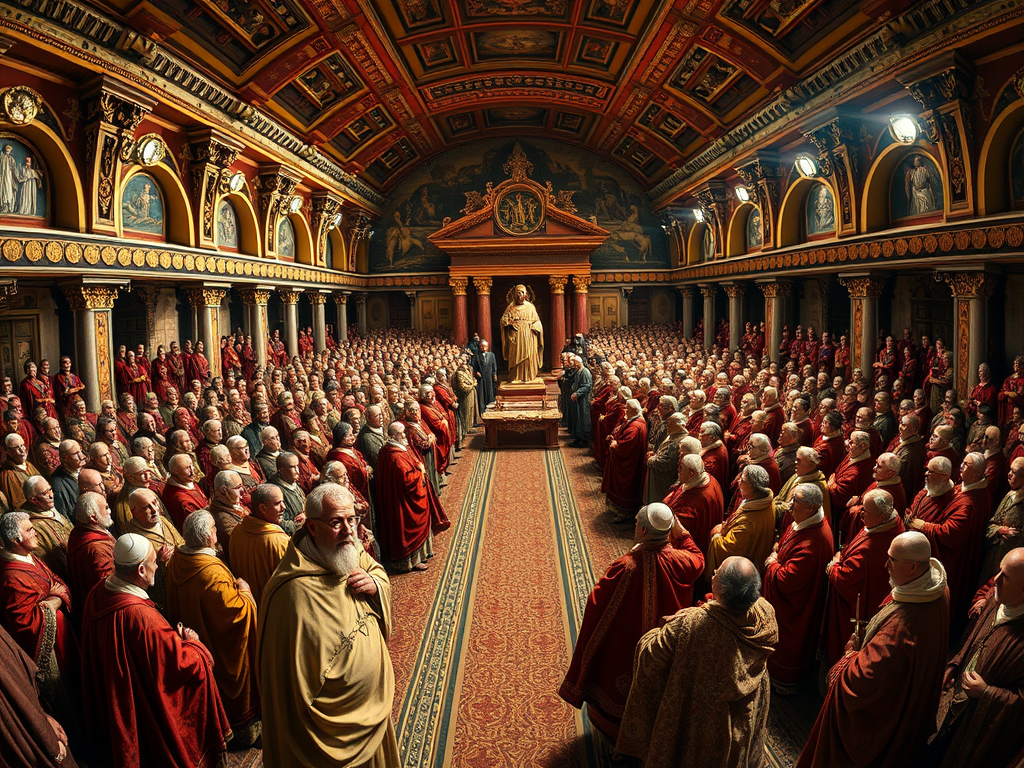
Nicaea I (325 AD) is the first Great Ecumenical Council of the undivided Church. There are volumes of historical and theological writings that cover a vast amount of information. John Behr’s The Way to Nicaea and The Nicene Faith are regarded as the standard texts for a robust but accessible historical-theological approach to understanding the events and the theology of Nicaea I. For an introductory and accessible read on the theology of Nicaea and its implications for modern evangelical churches, Ford and Wilhite’s Nicaea for Today is the most recently released text on this subject matter and is profitable for the average Christian.
Percival also recognizes the vast volumes of work written on the assembling of Nice, the Creed, and the canons of Nice, stating, “The history of the Council of Nice has been so often written by so many historians, from the time of its sitting down to to-day, that any historical notice of the causes leading to its assembling, or account of its proceedings, seems quite unecessary”(Percival, 2). In an effort to provide meaningful and modern SBC theological dialogue with Percival’s work, I will be using Ford’s and Wilhite’s book to give some historical-theological insight to the Nicene Creed in order to retrieve theology that can be accepted and applied by Southern Baptists.
Percival’s Perspective on the Patristics Witness
One thing Percival asserts concerning the editors and commentators of his book that was quite intriguing was their perspective on the theological intentions of the Seven Ecumenical Councils. He writes,
“The editor, however, ventures to call the attention of the reader to the fact that in this, as in every other of the Seven Ecumenical Councils, the question the Fathers considered was not what they supposed Holy Scripture might mean, not what they, from á prior arguments, thought would be consistent with the mind of God, but something entirely different, to wit, what they had received. They understood their position to be that of witnesses, not that of exegetes. They recognized but one duty resting upon them in this respect— to hand down to other faithful men that good thing the Church had received according to the command of God” (Percival, 2).
This perspective treats the fathers and those who attended the councils as fellow witnesses of the pillar and foundation of truth, which is the church (1 Tim. 3:15). These essential truths of the church were passed down through apostolic succession to the Church universal. This is most likely the reason why Scripture verses are not directly quoted in the creeds or canons of the councils, because the theology they set forth was inherently Scriptural and accepted as infallibly true by the church. Percival writes further, “The question they were called upon to answer was not, What do I think probable, or even certain, from Holy Scripture, but What have I been taught, what has been instructed to me to hand down to others?” (Percival, 2)
Most of the time, protestants (and I do include myself in this group) read the councils through a protestant lens, assuming that the early church fathers were sola scripturaists, but Percival’s perspective does not grant a sola scriptura paradigm when considering the theological conclusions of the councils. The early church held the tradition and authority of the church in high regard, almost as high as Scripture. This is not to say that the councils did not hold high views of the Scripture. The creeds and canons are saturated in Scriptural truth, resulting in authoritative theological and practical doctrine and guidance. The councils may not quote scripture directly, but it is evident that Scripture influences and guides their thinking. The bishops of the councils most likely believed that their theological and ecclesiastical decisions were a work of the Holy Spirit, applying the unchanging truths of Scripture for the purity of the church. They viewed themselves as being a continuation of Peter, James, John, Paul, the Apostles, etc., faithfully exercising the succession of leadership from the Apostles, and ecumenically making authoritative decisions similar to that of the Jersualem Council (Acts 15).
The Nicene Creed 325AD
This brings us to the Nicene Creed of 325AD. Percival notes the following concerning the Nicene Creed and the discovery of its record,
“Found in the acts of the Ecumenical Councils of Ephesus and Chalcedon, in the Epistles of Eusebius of Caesarea to his own Church, in the Epistle of St. Athanasius Ad Jovianum Imp., in the Ecclesiastical Histories of Theodoret and Socrates, and elsewhere, The variations in the text are absolutely without importanceI.”
The record of the Nicene Creed of 325AD is an ancient writing preserved within the later Councils, the writings of the historian Eusebius of Caesarea,1 and of St. Athanasius whose work was of great importance to the orthodox theology of the Nicene Creed. Whatever textual variants were available to Percival, he claims that they were not of any important significance, and in his book, he makes no note on the variations of the text. The Council of Nicaea consisted of one Ecumenical Creed and XX Canons (Rules of the Faith).
The following creed is the full text of the Creed, followed by the ancient anathema
The Synod at Nice set forth this creed
The Ecthesis of the Synod at Nice.2
We believe in one God, the Father Almighty, maker of all things visible and invisible;
And in one Lord Jesus Christ, the Son of God, the only-begotten of his Father, of the substance of the Father, God of God, Light of Light, very God of very God, begotten (γεννηθέντα), not made, being of one substance ( ὁμοούσιον, consubstantialem) with the Father. By whom all things were made, both which be in heaven and in earth. Who for us men and for our salvation came down [from heaven] and was incarnate and was made man. He suffered and the third day he rose again, and ascended into heaven. And he shall come again to judge borth the quick and the dead.
And [we believe] in the Holy Ghost.
And whoever shall say that there was a time when the Son of God was not (ἤν ποτε ὃτε οὺκ ἤν), or that before he was begotten he was not, or that he was made of things that were not, or that he is of a different substance or essence [from the Father] or that he is a creature, or subject to change or conversion– all that so say, the Catholic and Apostolic Church anathematizes them.
Interacting with Percival’s work and Ford and Whilhite’s work will provide a balanced, non-evangelical, and Baptistic perspective on the Nicene Creed. My aim is to provide theological, historical, and ecumenical insight to the Creed over several blogs.
Southern Baptist Ecclesiology and the Nicene Creed
As I argued in my previous blog, the Roman Catholic (RC) and Orthodox Church (OC) arbitrarily make claims of being the “true church” and the true inheritors of the councils of the past. These claims are based on how close their ecclesiastical heritage is to the Great Schism of 1054. Since the schism created two distinct churches—the RC and the OC—each having excommunicated the other, neither of them can claim to be the undivided church that produced the councils. Therefore, their arbitrarily self-proclaimed authenticity of being the true inheritors of the councils and their theologies is just as valid as the SBC’s. Yes, we as the SBC can claim the Seven Ecumenical Councils, the minor Synods, their Creeds and Canons as our own, and we can study, glean, use, and adopt the richness of the past for our own ecclesiology.
As it pertains to the ecclesiology of the SBC, the theology of the Nicene Creed is important to the theology of the SBC. The Nicene Creed’s rich theological truths have been the infallible truths of the universal church for 2000 years. Disregarding and disassociating with the heritage of the past does a disservice to the strength of the SBC’s future. The governing theology of the SBC is the Baptist Faith and Message 2000. This rule of faith of the SBC is a great foundation to govern the body of churches that are in friendly cooperation with one another within the denomination, and the beauty of this document is that it does not prevent state associations, local associations, or local sbc churches from adopting the theology and canons of Nicaea into its own ecclesiology. The BFM 2000 is robust enough to govern all our churches but general enough to allow the aoption of greater theologies to strengthen the local churches.
I am not suggesting that the national SBC adopt the Nicene Creed into its BFM 2000. What I am suggesting is that local association and local churches should seriously consider adopting the Nicene Creed, the Canons of Nicaea, and all of its theological richness and ecclesiastical wisdom along with the BFM 2000. Over the next several weeks, my task will be to retrieve theological and ecclesiological insights from the Nicene Creed and the Canons of Nicaea and apply them to local SBC associations and churches while remaining faithful to the BFM 2000.
- Francis Joseph Bacchus, “Eusebius of Cæsarea,” The Catholic Encyclopedia, vol. 5 (New York: Robert Appleton Company, 1909), New Advent, accessed December 11, 2025, https://www.newadvent.org/cathen/05617b.htm ↩︎
- An “Ecthesis” is a “statment of faith” or “an exposition.” ↩︎

 Reformed Perspective