
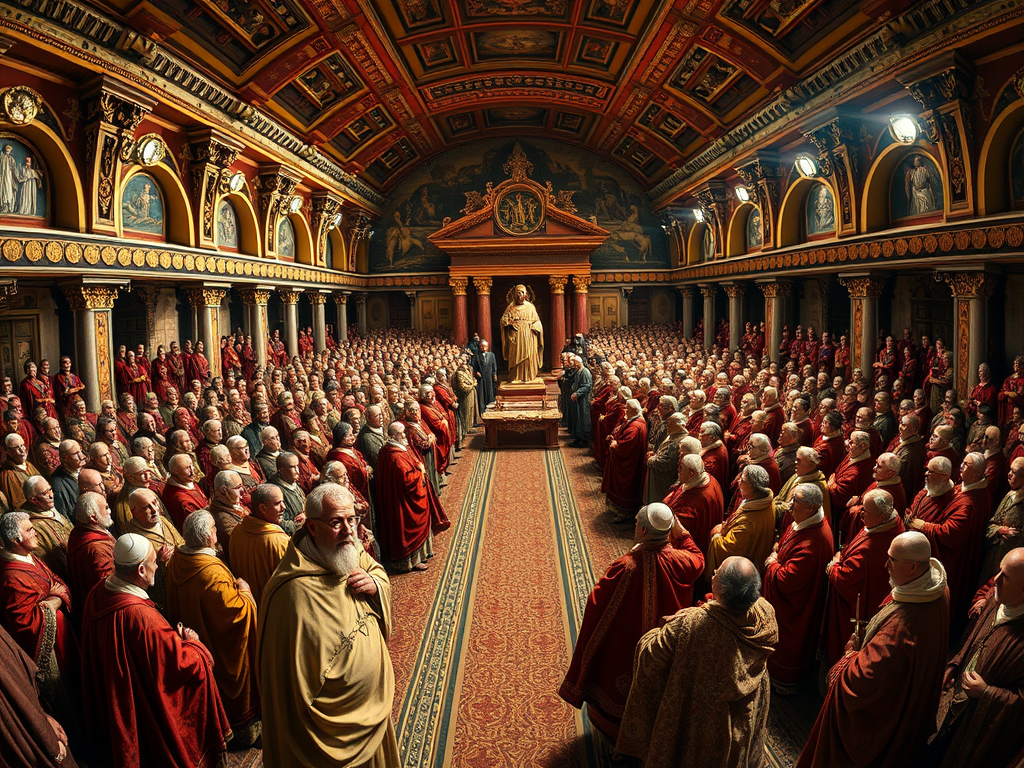
To document my thoughts on this book, I will periodically release summaries of the content I read, as a single review is insufficient due to its vastness and complexity.
I. Method of Treatment
The book begins by stating that both the East and West (the Orthodox Church and Roman Catholic traditions) accept the first seven ecumenical councils. By “accepted,” Percival means that neither side denies the authority of the theological and ecclesiastical decisions made by these councils. The acceptance of the seven greater councils (Nicaea 325, Constantinople 381, Ephesus 431, Chalcedon 451, Constantinople II 553, Constantinople III 680-681 and Nicaea II 787) also includes the acceptance of several smaller ecumenical synods that are later accepted by the greater councils.
Each of the greater councils established essential dogmas through theological creeds and canons (rules). The theological creeds were infallible theological dogmas of the church that combatted heresy and established essential doctrines of the faith. The canons were rules of faith that guided social issues, church practices, leadership matters, and the traditions of the Christian community. Percival also includes the Ancient Epitomes of the creeds and canons. These Epitomes were succinct summaries accepted by the church to provide further clarity on the intention behind the creed or canon. Added to these Epitomes are Notes, which were “taken from most of the great commentators, and Excursuses, largely made up from the writings of the greatest theologians, canonists, archaeologists, etc., with regard to whom and their writings, all the information that seems necessary the reader will find in the Bibliographical Introduction.” (Percival, XI)
II. Concerning Ecumenical Councils in General
Percival highlights the difference between recognizing the authority of the Great Councils, which are universally accepted, and the Ecumenical Synods, which had fewer attendees and did not gain universal acceptance right away. Percival writes, “An Ecumenical Synod may be defined as a synod, the decrees of which have found acceptance by the Church in the whole world.” (Percival, XI) Percival is not proposing that all Protestant churches accept these councils by using the phrase ‘in the whole world’; rather, he is saying that the Orthodox Church (OC) and Roman Catholic (RC) churches accept them universally.
Percival argues that the size of the synod is not what validates its veracity. There were 325 bishops at Nicaea and 150 at Constantinople I. He even argues that these synods do not even necessarily have to be assembled with the intention of being ecumenical.
“Such was not the case with I. Constantinople, it is not necessary that all parts of the world should have been present or even that bishops of such parts should have been invited. All that is necessary is that its decrees find ecumenical acceptance afterwards, and its ecumenical character be universally recognized.” (Percival, XI-XII)
Percival acknowledges that the early Church held numerous “general councils” that were never accepted and that many of them contained theological errors. For example, the “Latrocinium and the spurious ‘Seventh Council’ held by the iconoclastic heretics” (Percival, XII).1
The greater Ecumenical Councils claimed for themselves an immunity from error in their doctrinal and moral teaching, resting such claim upon the promise of the presence and guidance of the Holy Ghost. (Percival, XII)
It is important to note that just because a council proclaims itself to be infallible that this does not automatically make a council infallible. An arbitrary self-proclaimed infallibility does not make the council or synod infallible. Percival clarifies saying that “the council looked upon itself, not as revealing a new truth, but as setting forth the faith once for all delivered to the Saints.” (Percival, XII) This is the foundation of the RC and OC argument to establishing the infallibility of a council. It is not based upon the assembly, nor the presence of a pope or ruler, but on the faith passed down once for all. This transmitted faith consists of the teachings handed down through apostolic succession and ultimately confirmed by the authoritative, infallible, and unchanging Scriptures. Percival continues, “Its decisions therefore were in themselves ecumenical, as being an expression of the mind of the whole body of the faithful, both cleric and lay, the sensus communis of the Church” (Percival, XII). This protection from error rests on the Lord’s own promise that “the gates of hell shall not prevail against His Church.” However, the RC Church makes a special claim of authority for the Papal See as the sole head “visible church” and therefore, they claim that these councils are authoritative only because the Roman Pontiff has accepted them.
However, Percival notes how different Ecumenical Councils were called together and concluded by different ruling heads. His intention is to argue that the need for papal oversight or papal presence is unnecessary to establish the veracity of a council. Percival writes,
The Seven Ecumenical Councils were all called together at the commandment and will of Princes; without any knowledge of the matter on the part of the Pope in one case at least (1st Constantinople); without any consultation with him in the case of I. Nice, so far as we know; and contrary to his expressed desire in at least the case of Chalcedon, when he only gave a reluctant consent after the Emperor Marcian had already convoked the synod.” (Percival, XII)
The Roman Catholic Church claims a unique authority in the See of Rome. They argue that Christ gave Peter the “keys of heaven” to establish the Church, and that this authority extends to the universal Church. Since the See of Rome is regarded as Peter’s successor, the pope is therefore considered necessary to declare councils infallible under this special authority. However, Percival’s argument suggests that at least three of the seven great councils were assembled, overseen, and accepted by someone other than the See of Rome. Percival writes,
And in the first place it is evident that no council has been accepted as ecumenical which has not been received and confirmed by the Roman Pontiff. But, after all, this is only saying that no council has been accepted as ecumenical which has not been ecumenically received, for it must be remebered that there was but one Patriarchate for the whole West, that of Rome; and this is true to all intents and purposes, whether or no certain sections had extrapatriarchal privileges, and were “autocephalous”2 (Percival, XIII).
Therefore, Percival acknowledges that the Roman See has received and affirmed the seven councils as infallible, but he maintains that this acceptance does not confer infallibility; it merely recognizes what was already universally accepted and inherent in the councils themselves.
III. The Number of Ecumencial Councils
It is universally accepted by the RC and OC that Nice I, Constantinople I, Ephesus, and Chalcedon are ecumenically infallible. Most Protestant and even some Evangelical churches accept the creeds (thought not the canons) as infallible as well. Percival appeals to St. Gregory the Great to argue for the veneration of these first four councils in the early church. St. Gregory writes, “I venerate the first four Ecumenical Councils equally with the Four Gospels (sicut quator Evangelia.)”3 Percival also claims that the fifth and sixth ecumenical councils were eventually accepted, though the fifth was not so readily accepted in certain places as the sixth. As for the seventh council Percival writes,
The Ecumenical character of the seventh is not disputed by East or West and has not been for near a thousand years, and full proof of its ecumenicity will be found in connection with that council. (Percival, XV)
These seven Ecumenical Councils then were full accepted and adopted by the undivided church for nearly seven centuries beginning with Nicaea I (325) until the Great Schism (1054). My task with these seven councils, their creeds and their canons, is to integrate the theology, the ecclesiastical authority, and its practices into the modern evangelical church. Observing and integrating more than just the creeds of these councils is essential to maintaining a humble posture for the great work of the past while looking to the future.
IV. Retrieval for Southern Baptist Ecclesiology
Since the Roman See is not necessary to validate the infallibility of the Seven Ecumenical Councils, communion with the Roman Catholic Church is likewise not required in order to receive and uphold the theological doctrines affirmed by those councils. This forms the basis of the Orthodox Church’s argument against Rome: the OC contends that it need not be in communion with Rome because it preserves the faith handed down to them through apostolic succession and by adherence to the seven ecumenical councils. This tension persists given that both churches excommunicated one another in 1054 and each claims to be the rightful heir of the undivided Church.
Logically, what follows, is that it is not required to become a member of the OC either nor to have communion with the OC in order to accept the councils and their theologies and adopt them into your local protestant or evangelical congregation. The Orthodox and Roman Catholic Churches both make ecumenical claims to be the true heirs of the councils and their theologies, yet by their own reasoning, they ground these claims in apostolic succession while simultaneously asserting that the other is out of communion with the true Church (themselves).
Their claim to be the “true church” stems from a direct lineage or pedigree of apostolic succession. Rome claims Peter and/or Paul and the OC claim the succession of the other eleven. However, by their own admission, they would agree that the church was undivided during the gathering and conclusion of these councils, so neither of their current modern institutions would be the undivided church that held and concluded these councils. This entails that they cannot make any exclusionary claim about being the “one true, holy, catholic, and apostolic church” when they themselves are not that institution that gave us the councils to begin with.
What does this mean for Southern Baptists? It means they we can make the same kind of claim about the heritage of the past. The Southern Baptist Convention can track their ecumenical lineage down to the Anabaptist, who seceded from Ulrich Zwingli (a Swiss Reformer who was ordained as a Catholic Priest) who seceded from the Roman Catholic Church who is descended from Peter. These kinds of claims to the heritage of the church are arbitrary and the “closeness” of the institution to the undivided church (by closeness I am referring to the number of schisms) are created by the ancient institutions to anathematize all other traditions that they themselves do not recognize.
Since Southern Baptists can make the same kind of arbitrary claim to the past as the RC and the Orthodox, that means that the SBC can refer to, use, adopt, and accept the theologies of these councils and synods for their own ecclesiology. There is so ecumenical wisdom and theological gold that can be mined in the seven councils that were universally accepted. The SBC’s aversion to ancient traditions and ecclesiology has only left us divorced from the richness of the past. My task will be to release different writings on the Councils, the Creeds, the Canons and the Synods and how the SBC can retrieve the theology from the past and utilize the wisdom of the ancients and the patristics to create a stronger association of local churches and SBC entities.
- For more on the Latrocinium visit: https://www.newadvent.org/cathen/05495a.htm ↩︎
- For a greater definition of autocephalous or autocephali: https://www.newadvent.org/cathen/02142a.htm ↩︎
- Gregory the Great, Letter I in Nicene and Post-Nicene Fathers, Second Series, Vol. XII, “Book I. Indiction IX., Being the First Year of His Ordination,” accessed December 4, 2025, https://www.tertullian.org/fathers2/NPNF2-12/Npnf2-12-228.htm#P4744_1501339 ↩︎

 Reformed Perspective