
My General Introduction
This journey of discovering and studying the early church fathers (1st-4th Century) and their writings, as well as their work, began in a seminary class at Gateway Seminary during a semester-long study of the Holy Spirit and the early patristics. Dr. David Rathel, a brilliant and godly man, with care and love, has graciously put up with my incessant theological inquiries. He introduced me to the early writings of Tertullian, Athanasius, and the Cappadocians and their theologies on the Divinity and Personhood of the Holy Spirit in the Spring of 2024. This is where my love for the early church fathers was ignited. A fresh breath of theological wind re-entered my soul that was burning out. Through the early church, my heart has found vigor once again in the Scriptures and in theology.
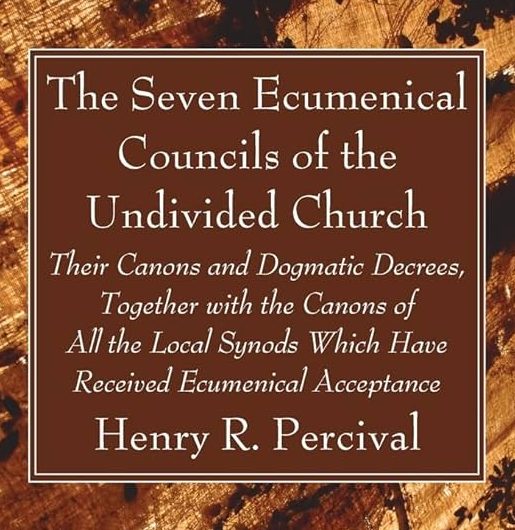
After a year and a half of taking another course in the Spring of 2025 with Dr. Rathel on Paterology (the study of Monarchical Trinitarianism in Tertullian and Origen) and an introductory course with Dr. Shawn Whilhite on early patristics and Nicaea during the Summer of 2025, I found myself studying the Rule of Faith, Normative Authority, and Apostolic Succession. Which has now led me to Henry R. Percival’s, The Seven Ecumenical Councils of the Undivided Chruch: Their Canons and Dogmatic Decrees, Together with the Canons of the Local Synods which have Received Ecumenical Acceptance. If you are thinking, “That is a mouth fool,” yes it is and so is the 671 pages of material that follow the title.
Why Study this book?
From the start of my theological education in 2014 until now (December 2025), I’ve been given only small glimpses into the early church—its fathers, its councils, and its deep influence on our faith. In much of the evangelical and Protestant church, the very idea of studying the early church is often met with sighs or indifference. Bible study, personal devotions, and journaling are treated as superior forms of piety, while the traditions of the past are largely overlooked. Yet the early church’s work continues to shape my faith and that of the modern church as well, even though the evangelical and Protestant world tends to revere it only from a distance. Evangelicalism and Protestantism should be more willing to give credence to the past while looking to the future. After all, the canon of Scripture, the essential doctrines of the faith, the establishment of a universal church, the practices of ecclesial liturgy, and so much more are owed to the ancient church, its bishops and the saints.
Because the modern church owes so much to the past for the formation of our faith, our Scriptures, our liturgy, and our traditions, this book is important to study. Below are my reasons why you should consider reading and studying this book.
- If you are ignorant of the first seven ecumenical councils of the early church, this provides great historical and contextual information and insights.
- If you are only familiar with the creeds and some of the events leading up to the creeds, this will deepen your understanding of the canons of the councils and the historical significance of the canons.
- The first universally accepted canons of Scripture were identified and accepted by the councils.
- You get a glimpse of how the church ecclesiastically dealt with heresy, misconduct, leadership, and social issues.
- It will give you a greater appreciation for the work of the past patriarchs of the church and the great efforts they made to maintain a holy, universal, and apostolic church.
A renewed engagement with the early church is not merely an academic exercise but an act of humble gratitude to the great works of the past. By studying its councils, canons, and convictions, we remember that our faith was not born in a vacuum but carefully shaped, clarified, and preserved by those who came before us. This book invites us to step beyond modern assumptions, recover the wisdom of the ancient church, and allow its witness to deepen our understanding, strengthen our devotion, and enrich the life of the church today.

 Reformed Perspective